
Search Lac qui Parle County Probate Records
Lac qui Parle County probate court records are filed and maintained at the District Court in Madison. The court handles estate cases, admitted wills, guardianship appointments, conservatorship proceedings, and trust matters for residents throughout the county. Probate records dating back to 1868 are on file at the courthouse. Records from July 1, 2015 onward are searchable at no cost through Minnesota Court Records Online, with older records available through direct contact with the court in Madison.
Lac qui Parle County Overview
Lac qui Parle County District Court
The Lac qui Parle County District Court is located in Madison and is part of Minnesota's Eighth Judicial District. Court Administrator Lindsay Listul oversees day-to-day operations. The court has original jurisdiction over all civil, family, probate, juvenile, criminal, and traffic cases in the county. A public court calendar posts each business day at 7:00 a.m. and updates hourly. Free public parking is available at the courthouse. The office is open weekdays during standard hours.
| Court Name | Lac qui Parle County District Court |
|---|---|
| Address | 600 Sixth Street, Madison, MN 56256 |
| Phone | (320) 295-4000 |
| Fax | (320) 598-3915 |
| Hours | Monday–Friday, 8:00 AM – 4:30 PM |
| Court Administrator | Lindsay Listul |
| Judicial District | Eighth |
Lac qui Parle County is a rural county in west-central Minnesota along the South Dakota border. All probate matters for the county are filed at the Madison courthouse. The court's probate docket dates back to 1868, making it one of the longer-running in the region. Call the court before visiting if you have questions about specific records or filing requirements.
Searching Lac qui Parle County Probate Records
The MCRO portal covers Lac qui Parle County probate records filed from July 1, 2015 forward. You can search by party name or case number. Most records are public. For filings before July 2015, contact the court at (320) 295-4000 or visit the Madison courthouse in person. Given that Lac qui Parle County's probate records begin in 1868, there is an extensive archive of older estate files worth exploring if you are researching family history.
The Minnesota Historical Society's probate guide explains what older records are available statewide and how to access them. MNHS holds historical will books and estate records for many counties through the mid-1980s. After that period, records are held by the courts. For Lac qui Parle County records from the 1800s and early 1900s, contacting MNHS is often the fastest route.
What Lac qui Parle County Probate Records Include
Probate court records in Lac qui Parle County document the legal transfer of a deceased person's property. When someone dies leaving assets in their name, those assets usually need to pass through the District Court before they can be distributed to heirs. The court file for an estate typically includes the petition to open the case, any will admitted to probate, letters testamentary or administration, an inventory of assets, creditor claim records, and the final distribution order.
Guardianship records are also part of the probate docket. These cases involve the court appointing someone to manage another person's personal decisions because that person is unable to do so on their own. Conservatorship records follow a similar structure but deal specifically with financial management. Both types of records are public unless a court order restricts access.
Lac qui Parle County's probate records going back to 1868 are a rich resource for genealogical research. Estate inventories from the 19th and early 20th centuries can show land holdings, livestock, farm equipment, and other property that passed through families in this agricultural region. Researchers tracing land transfers or inheritance patterns in western Minnesota frequently turn to Lac qui Parle County records.
How to File Probate in Lac qui Parle County
Minnesota gives you two main options for probate under Minn. Stat. Chapter 524: informal and formal. Informal probate is the simpler path. It does not require a court hearing. The registrar reviews the paperwork and appoints a personal representative by administrative order if everything checks out. This works when there is a clear will and no disputes among heirs. Formal probate requires a judge and at least one scheduled hearing. Use this path when there are questions about the will, disputes among heirs, or complex assets that need judicial oversight.
To start a case in Lac qui Parle County, file the appropriate forms at the Madison courthouse. All standard probate forms are at mncourts.gov/getforms/probate/. The first-paper filing fee is $325. Depositing a will for safekeeping without opening a full estate costs $27. Certified copies of filed documents cost $14 each. Uncertified copies are free. These fees apply to all probate case types: estates, trusts, guardianships, and conservatorships.
Note: Minn. Stat. § 524.3-108 sets a three-year limit on most probate proceedings, so it is best to open the estate promptly after a death rather than waiting.
Lac qui Parle County Probate Court Images
The screenshot below shows the Lac qui Parle County District Court page on the Minnesota Courts website. It has the courthouse address in Madison, phone number, fax, and office hours.
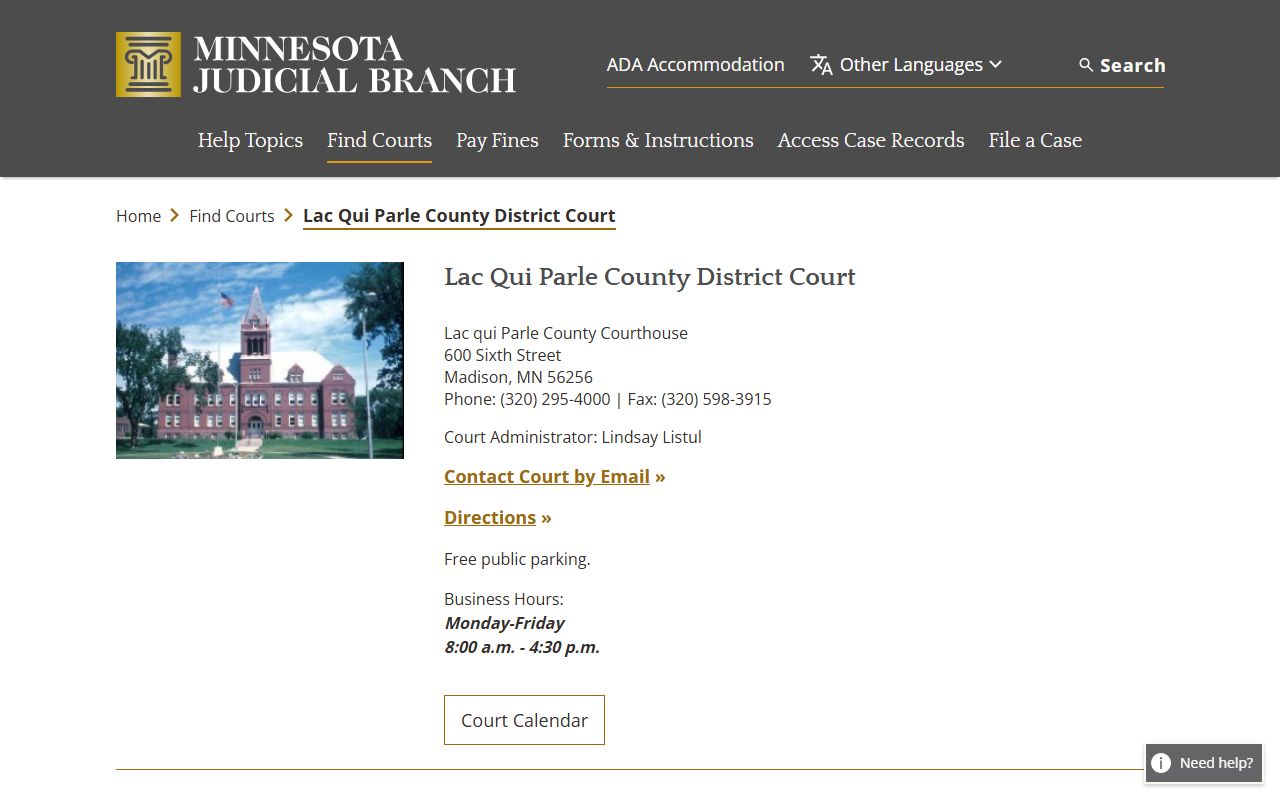
This page is the best reference for confirming current court contact information before calling or visiting Madison in person.
The screenshot below is from the Minnesota Revisor's website and shows Minn. Stat. § 524.3-1201, the small estate affidavit statute that governs how smaller Lac qui Parle County estates can transfer personal property without full probate.
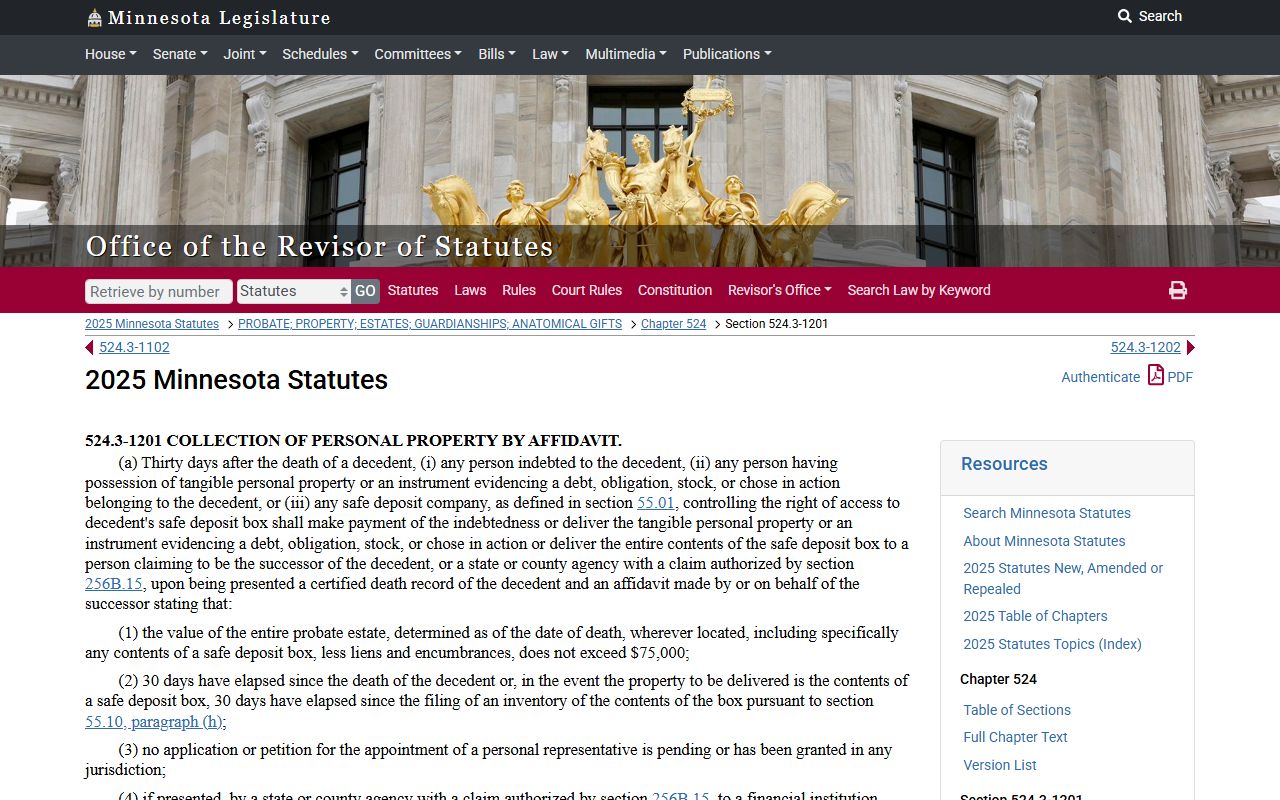
The statute sets out the $75,000 threshold and 30-day waiting period for using the small estate process, which applies in Lac qui Parle County the same as in every other Minnesota county.
Small Estates and Creditor Deadlines
Lac qui Parle County estates made up solely of personal property under $75,000 in value may qualify for the small estate affidavit process. The heir must wait at least 30 days after the death, then present a signed affidavit directly to the institution holding the asset. No court filing is needed. The form is PRO201/PRO202, available at mncourts.gov. Real estate is not covered by this process. The controlling statute is Minn. Stat. § 524.3-1201.
Creditors seeking to file claims against a Lac qui Parle County estate must meet the deadline in Minn. Stat. § 524.3-803: four months from published notice or one year from death, whichever comes first. After that window closes, most claims are barred. Personal representatives should publish notice in a timely way to start this clock. Free legal help is available through the Minnesota State Law Library, which provides access to statutes, court rules, and self-help materials.
Cities in Lac qui Parle County
Madison is the county seat and the largest community in Lac qui Parle County. Other towns include Dawson, Montevideo (which is in Chippewa County), and Watson. No Lac qui Parle County city meets the 100,000-population threshold for a dedicated city page, but all residents file Lac qui Parle County probate matters at the District Court in Madison.
Nearby Counties
Lac qui Parle County borders several west-central Minnesota counties, each with its own District Court handling probate filings.