
Minnesota Probate Court Records
Minnesota probate court records are public documents filed at the District Court in each county when someone dies with property in their name, or when a court appoints a guardian or conservator. You can search these filings through Minnesota Court Records Online or visit the courthouse in person. The state has 87 counties, and each one manages its own case files going back many years. Use this page to find Minnesota probate court records, understand what they contain, and locate the right courthouse for your search.
Minnesota Probate Court Records Overview
What Are Minnesota Probate Court Records
Probate court records in Minnesota document the legal process of settling a person's estate after death. A probate case gives a court authority to transfer property, pay debts, and distribute what is left to heirs or beneficiaries. The District Court in each county handles these cases. A typical probate file contains the original will (if one exists), a petition to open the estate, letters testamentary issued to the personal representative, an inventory of assets, notices to creditors, and final orders of distribution. These are all part of the public record kept at the county courthouse.
Three situations most often lead to a probate case in Minnesota. The most common is death. If a person owned property in their name alone that does not pass automatically through joint tenancy or a named beneficiary, the court must be involved to transfer it. Courts also handle guardianship cases when someone can no longer make personal decisions, and conservatorship cases when finances require oversight. Trusts that need court supervision also produce probate court records. All of these case types follow the same public access rules under the Minnesota Rules of Public Access.
Probate cases do not open automatically. Someone must file a petition or application at the courthouse in the county where the deceased person lived.
The Minnesota Judicial Branch maintains a comprehensive guide to the probate process at mncourts.gov/help-topics/probate-wills-and-estates. That page covers what probate is, when it is required, and how to start a case from scratch.
The mncourts.gov probate help page provides a solid starting point for understanding what you will find in a case file and how the court process works in Minnesota.
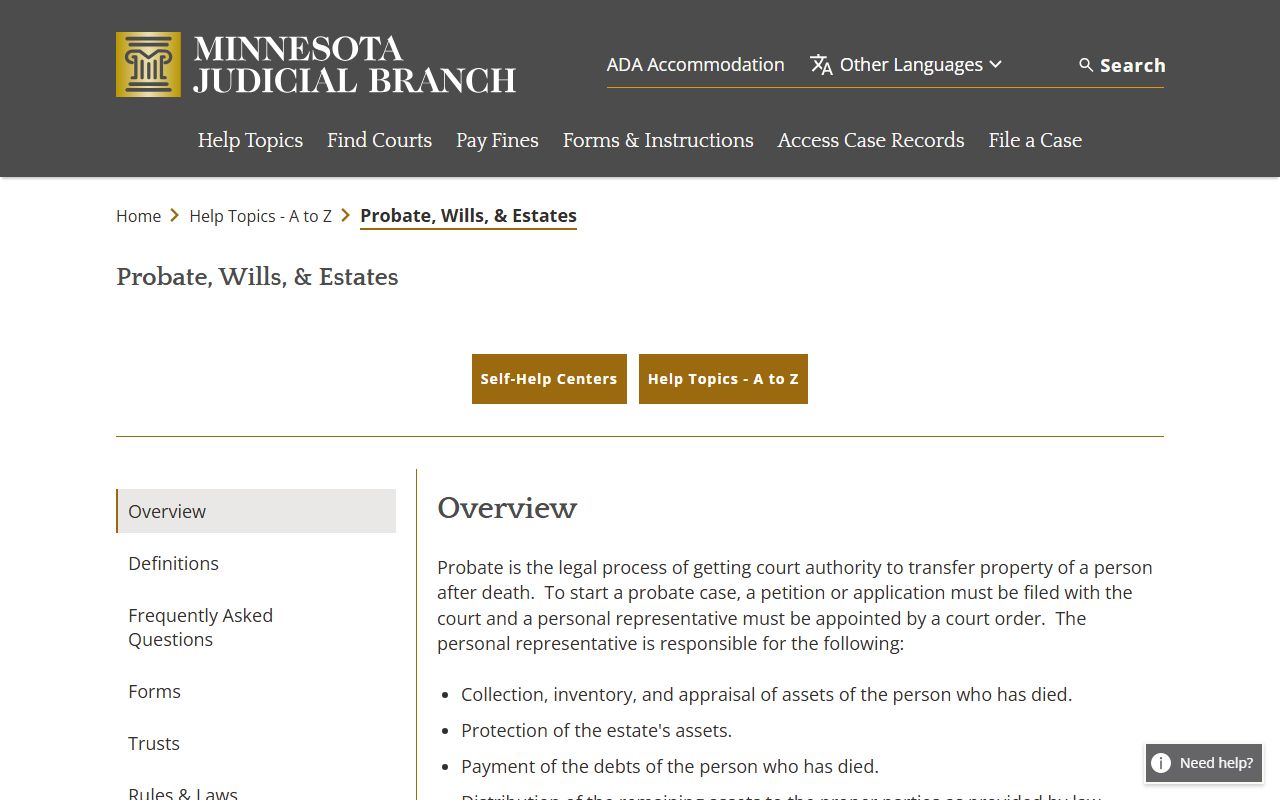
Bookmark this page if you are handling an estate and need a plain-language explanation of each step from filing to closing.
Note: Probate court records are filed and kept at the county District Court where the deceased person lived at the time of death, not at a central state office.
How to Search Probate Court Records Online
Minnesota Court Records Online, called MCRO, is the state's free public portal for court case data. It replaced the old Minnesota Public Access Remote system in March 2021, rolling out in phases across all 87 counties. You can use MCRO to find probate cases by person name, business name, attorney name, case number, or citation number. Results include party names, case type, filing date, current status, and links to documents that were filed on or after July 1, 2015.
MCRO offers four search types. Case search lets you look up any party in a probate case. Document search pulls all public documents in a specific case if you already have the case number. Hearing search shows scheduled court dates and times. Judgment search finds docketed money judgments by debtor name. The main portal is at publicaccess.courts.state.mn.us. It is free to use and available around the clock. System maintenance may interrupt access on Sundays from 9:00 AM to 4:00 PM.
The MCRO information page at mncourts.gov/access-case-records/mcro explains how the system works, what case types are included, and what documents are available online depending on when they were filed.
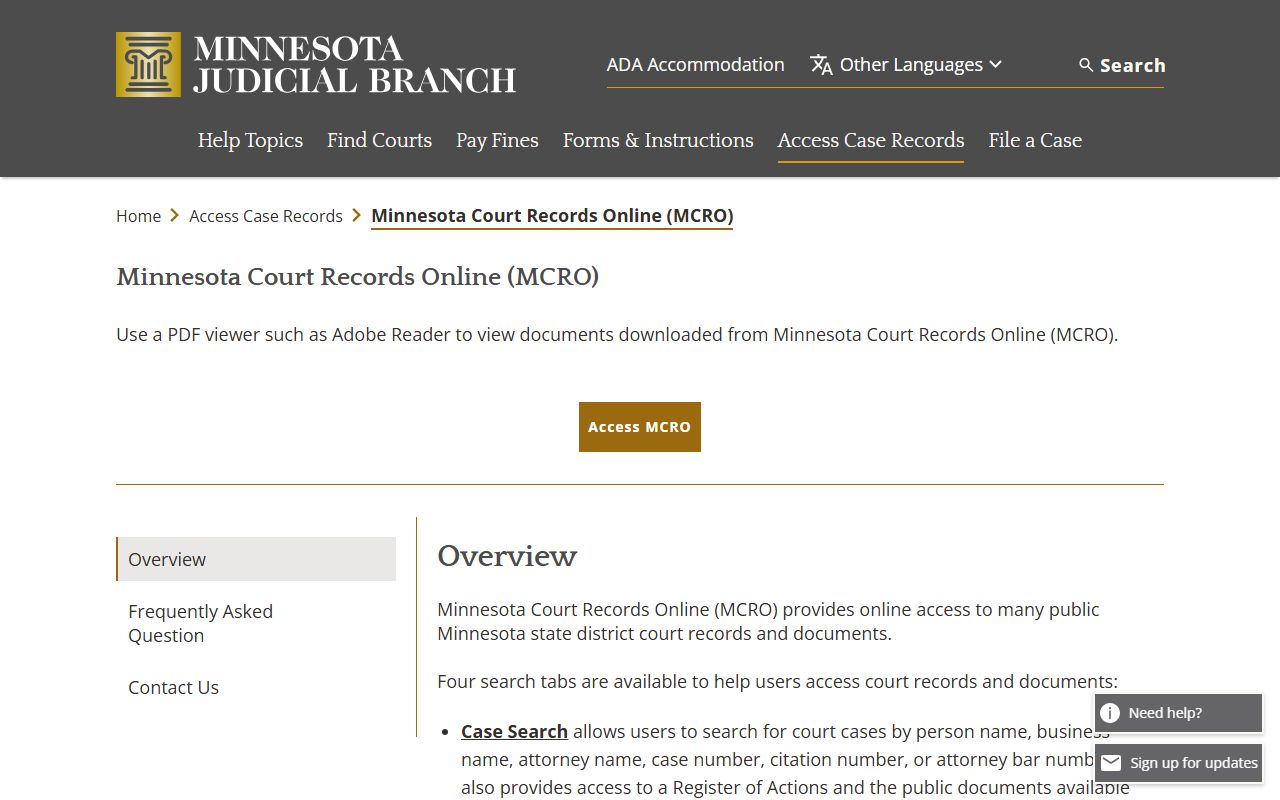
Quick reference guides for searching cases, documents, hearings, and judgments are listed on that page and can help you get the most out of each search type.
When you search by name in MCRO, enter the last name first, then the first name. Use an asterisk (*) as a wildcard for name variations. Case numbers in Minnesota probate follow the format: [county code]-PR-[year]-[sequence]. For example, a Hennepin County probate case might read 27-PR-21-1234. Documents filed before July 1, 2015, are generally not available online. For those older records, contact the Court Administrator in the county where the case was filed.
Note: MCRO does not include documents from civil commitment, domestic abuse, or harassment cases, and some probate records with restricted access will not appear in results.
Types of Probate Cases and Filings in Minnesota
Minnesota District Courts handle several types of probate cases, and each one generates its own set of records. Knowing which type applies to your situation helps you search more effectively and ask the right questions when you contact the courthouse. Estate cases are the most common. They open after a person dies. Minnesota law allows two paths: informal and formal. Informal probate is an application that moves through the court without a hearing when the situation is routine and uncontested. Formal probate requires a petition and a judge's hearing, used when the case is complicated or disputes may arise. Both types fall under Minnesota Statutes Chapter 524, the state's Uniform Probate Code. Informal proceedings start under Minn. Stat. § 524.3-301, and formal ones begin under Minn. Stat. § 524.3-401.
Guardianship cases open when the court appoints someone to make personal decisions for a person who can no longer do so on their own. This often involves elderly adults with dementia or people with serious disabilities. Conservatorship is closely related but covers management of a person's property and finances rather than personal care. Trust cases involve court oversight when a trust requires judicial supervision. Determination of descent is a fourth type of probate filing, used to establish who inherits property when no formal estate was ever opened, sometimes long after the death occurred. Real estate title problems often drive these filings.
Each case type produces records that follow the same public access rules under Minnesota court policy.
Minnesota Probate Forms and Filing Packets
The Minnesota Judicial Branch offers free probate forms for all case types on its website. Forms are organized by category and include step-by-step instructions. Find them at mncourts.gov/getforms/probate/. Categories include general probate, informal probate, formal probate, objection forms, closing forms, determination of descent, and small estate affidavits.
The probate forms directory on mncourts.gov lists every court-approved form by category, each linked to a packet with instructions for filing at your county courthouse.
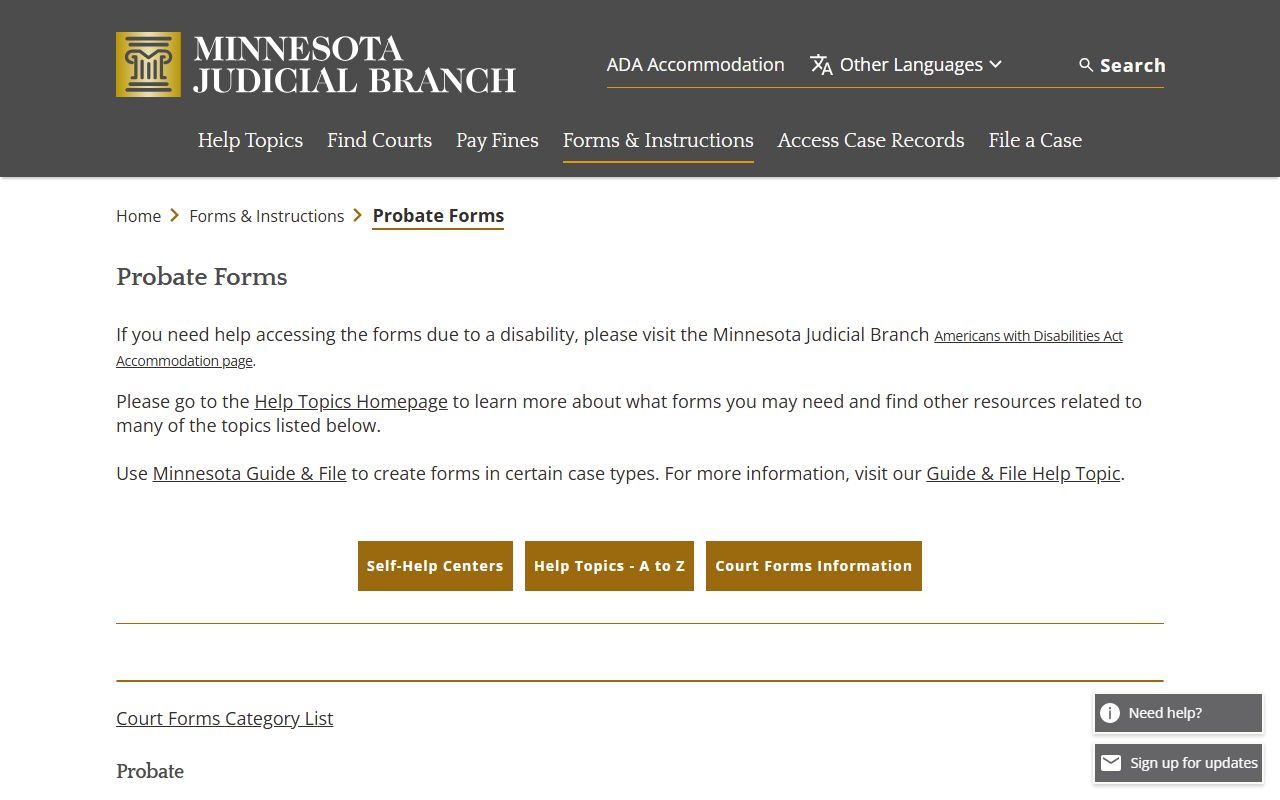
The directory is updated when forms change, so check back if you have been using an older version of any document before you file.
Key forms include PRO802 for applying to informally probate a will, PRO901 to nominate a personal representative, PRO903 to accept the appointment, PRO906 to issue letters testamentary, and PRO913 for the final account and proposal for distribution. PRO1401 handles petitions for determination of descent. Most forms work with the state's e-filing system. Form packets include all the pages you need for that step of the process, so you do not have to search for each form separately.
The formal probate packet at mncourts.gov includes forms PRO1201 through PRO1206, covering the petition for formal probate of a will, affidavit of service, and related documents needed to open a case with a will.
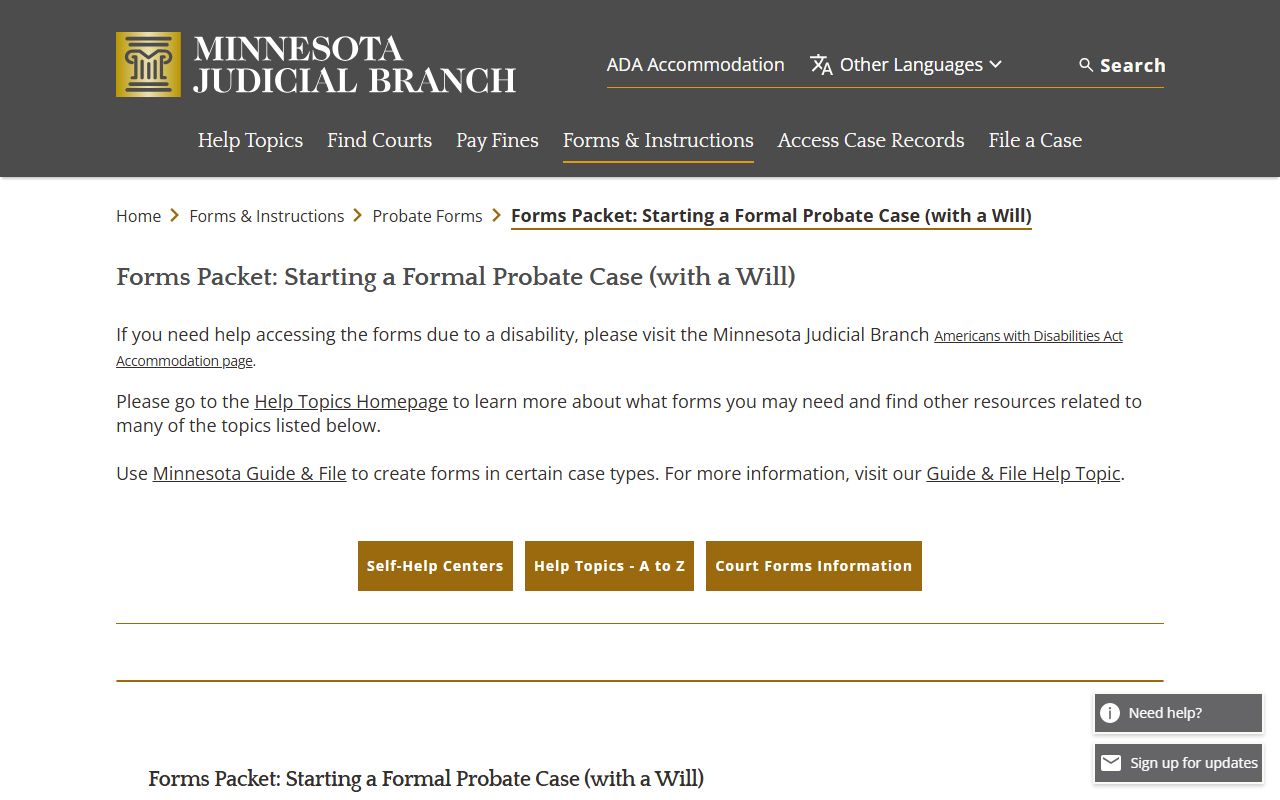
File these forms with the Court Administrator in the county where the deceased person lived when they died.
The small estate packet at mncourts.gov includes PRO201 instructions and PRO202 the affidavit itself, which lets you collect personal property without opening a court case when the estate qualifies.
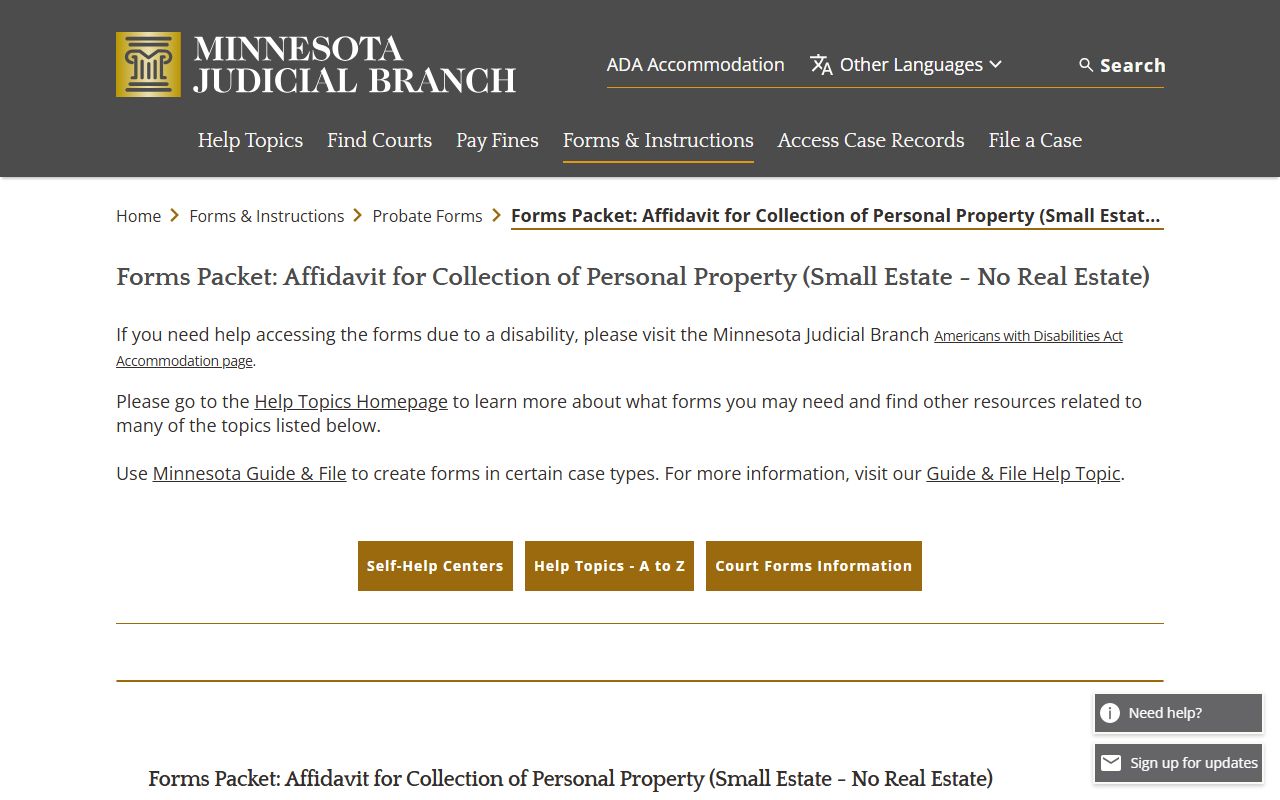
PRO201 and PRO202 are for estates under $75,000 with no real estate, usable 30 days after death without going to court at all.
Note: Always download the latest version of a form from mncourts.gov before filing, since forms are updated periodically and older versions may not be accepted.
The Small Estate Affidavit Alternative
Not every estate needs probate. Minnesota law gives a faster option for smaller estates through Minn. Stat. § 524.3-1201. If the total estate value is $75,000 or less and there is no real estate, a person entitled to inherit can use an Affidavit for Collection of Personal Property to claim assets directly. This avoids the court process entirely. You wait 30 days after the death, then present the signed affidavit along with a certified death certificate to whoever holds the property, such as a bank, employer, or brokerage. They are required to hand over the assets.
The statute also covers motor vehicles and securities. The registrar of motor vehicles must issue a new title when you present the affidavit. Transfer agents for stocks and bonds must also change ownership. The affidavit must state that the estate value is under $75,000, that 30 days have passed since death, that no probate case is open or pending, and that you are legally entitled to the property. If anyone objects or the key to a safe deposit box is missing, the institution does not have to open the box.
The statute text at revisor.mn.gov sets out every requirement for the affidavit in detail, making it easy to confirm you meet all conditions before presenting the document.
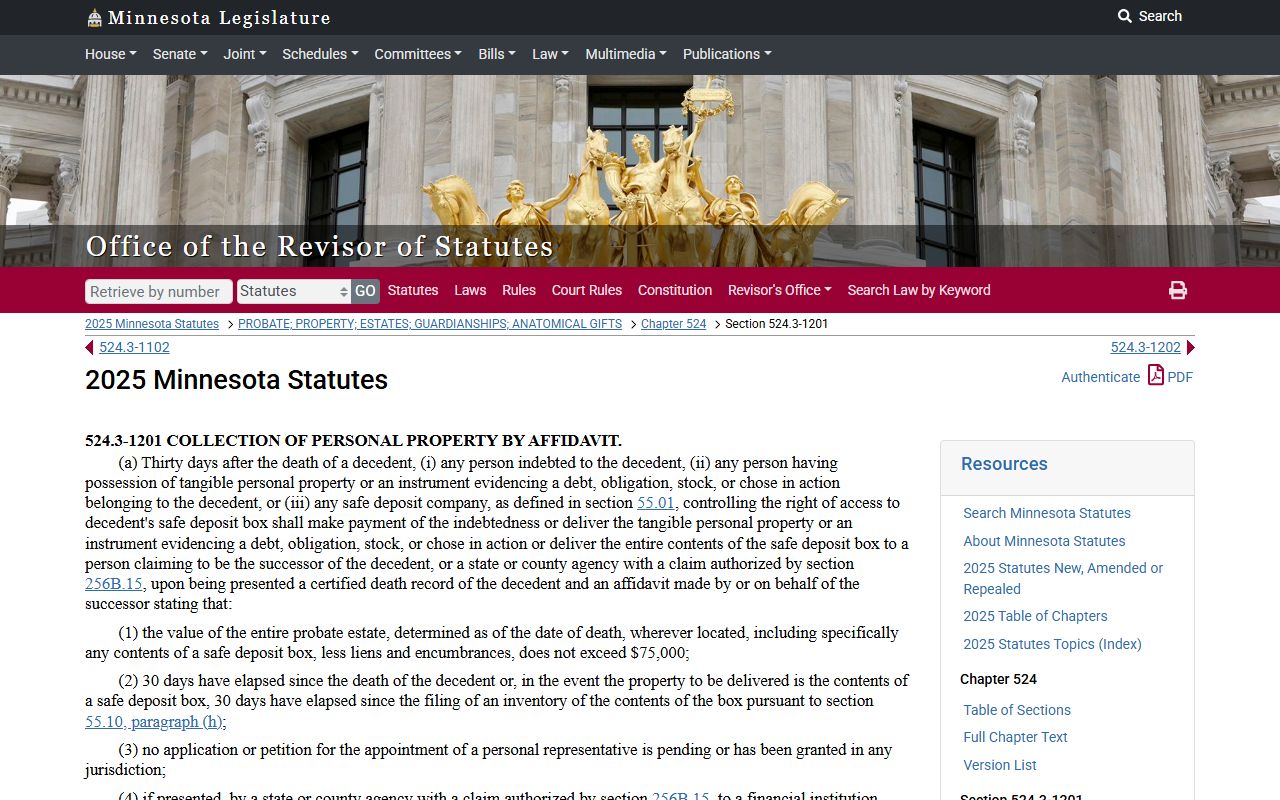
This statute page is also useful when talking with a bank or financial institution, since staff can see the exact legal authority behind your request.
Time Limits in Minnesota Probate
Minnesota law sets firm deadlines on probate proceedings. Under Minn. Stat. § 524.3-108, no informal probate or appointment proceeding may start more than three years after a person's death in most cases. There are limited exceptions, such as when there was genuine doubt about whether the person died, or when the case involves a missing or disappeared person. Will contests also have their own window. If you want to challenge an informally probated will, you must act within 12 months of the informal probate date or within three years of the death, whichever is later. Determination of descent proceedings, by contrast, have no time limit.
Creditor claims have separate deadlines tied to the notice process. All claims against a decedent's estate are barred if not filed within four months after the publication of notice to creditors, or within one year of the person's death, whichever comes first. Once that window closes, the claim is permanently gone against the estate, the personal representative, the heirs, and any beneficiaries. The personal representative can pay barred claims if the estate has the funds and it serves the estate's interests, but they are never required to do so.
The time limit statute at revisor.mn.gov lays out each deadline and the exceptions that apply in unusual situations, useful for anyone dealing with an estate that was not opened promptly after death.
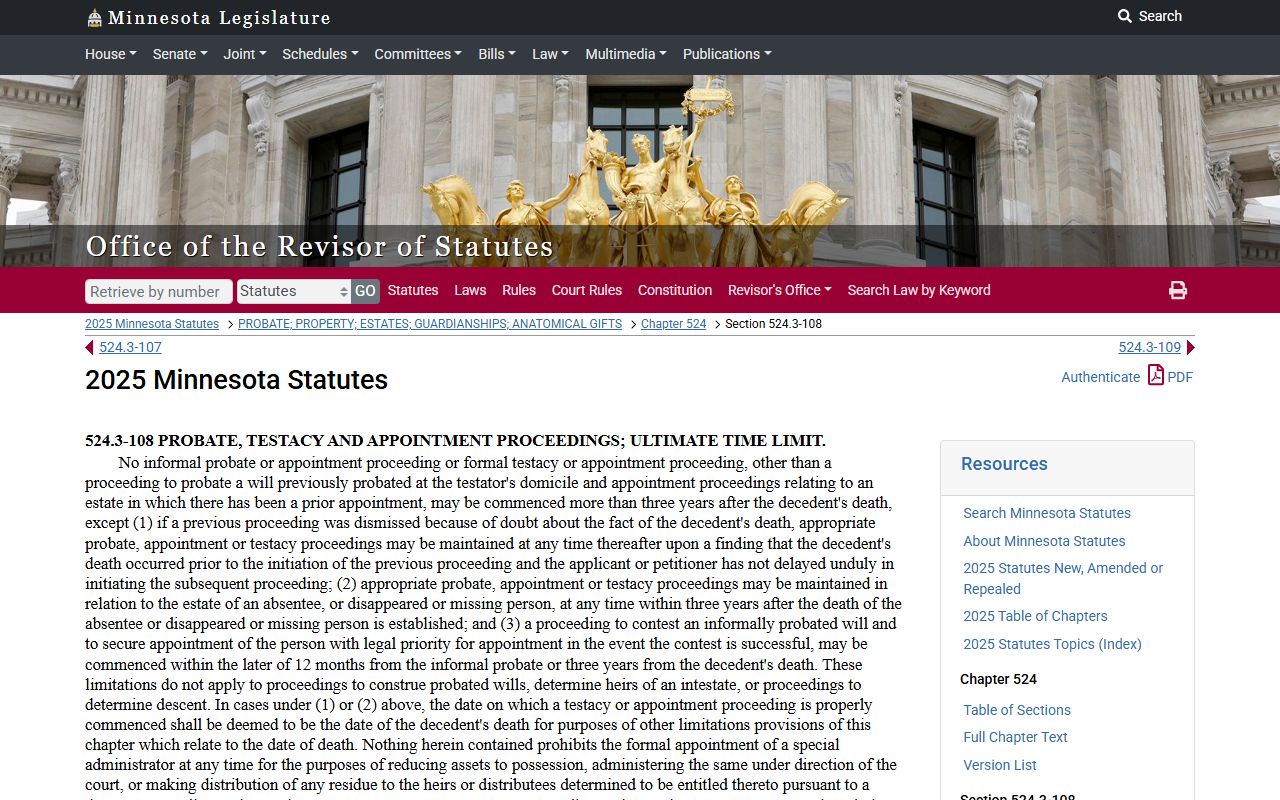
Understanding these deadlines matters whether you are a personal representative trying to close an estate, a creditor with an unpaid bill, or an heir who wants to contest a will.
Note: The three-year limit applies to starting a probate case, but a special administrator can be appointed at any time even after it expires for certain limited purposes.
Historical Probate Records in Minnesota
The Minnesota Historical Society (MNHS) holds copies of older probate records through its Gale Family Library. The library is at 345 West Kellogg Blvd., St. Paul, and is open Thursday through Saturday, 10:00 AM to 4:00 PM. Call (651) 259-3300 for research questions. The MNHS collection includes will books that date back to 1849 in some Minnesota counties. Will books are copies or transcriptions of wills that were probated by the courts, not the original documents. They are indexed on FamilySearch.org, which is free. Search by the deceased person's name and county to find an entry. Then contact MNHS to order a copy. Staff search one will record per request, and additional fees apply for each extra request.
Will books at MNHS are NOT official records. They cannot be used to produce certified copies. They are research tools for genealogical and historical work. Also note that MNHS does not hold will books for three counties: Hennepin (which includes Minneapolis), Marshall, and St. Louis (which includes Duluth). For those three counties, contact the court's record administration department directly to get copies of older probate filings. The request procedure at mnhs.org/library/services/will-book-record-request explains what information you need to order a will book record, including the volume number and image number from FamilySearch.
The MNHS probate records research guide walks through how to identify the right county, search the MNHS library catalog, and order historical probate documents from the society's collection.
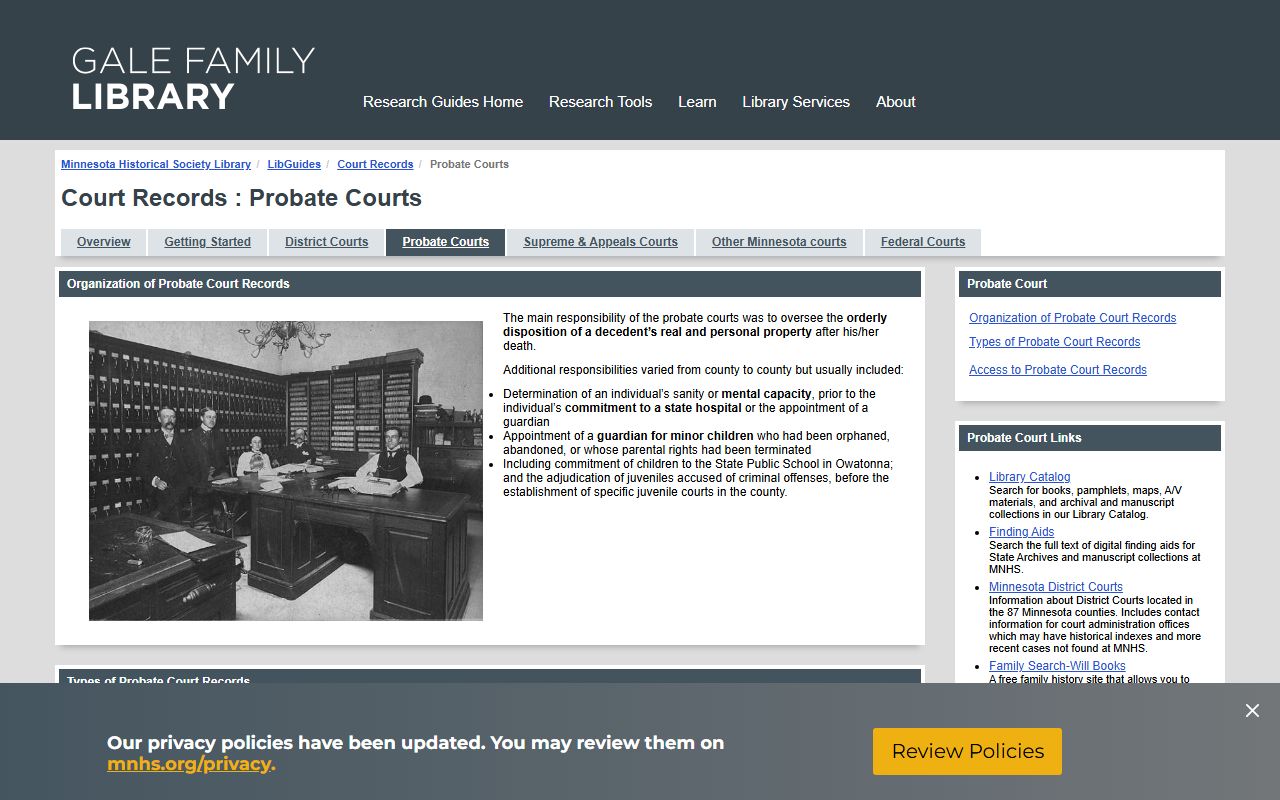
The guide at libguides.mnhs.org/courtrecords/probate also explains what record types MNHS holds, including case files, registers of actions, will books, insanity record books, and final decrees of distribution.
Most estate case files at MNHS are open to the public without restriction. Insanity case files less than 75 years old have special access rules, and library staff can explain what is needed. The University of Minnesota Law Library also has a guide to court records research in Minnesota at libguides.law.umn.edu/caserecords/minnesota.
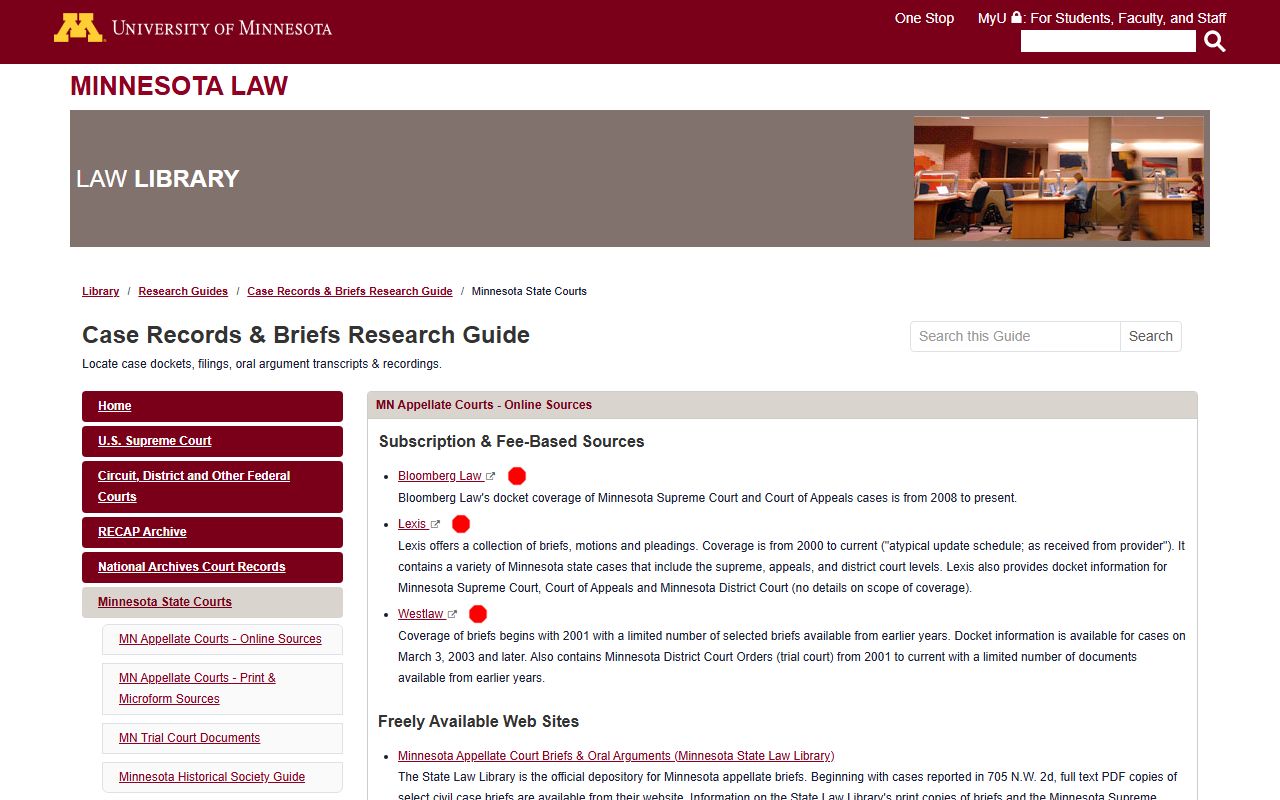
That guide covers current online search through MCRO and how to access older records that have not been digitized, including what is available at courthouses and archival collections.
What Probate Court Records Are Public
Most probate court records in Minnesota are open to the public. You do not have to be a party to the case. You do not need to explain why you want access. The personal representative's name, the estate's inventory of assets, notices to creditors, payment records, and final distribution orders are all part of the public file. You can view them at the county courthouse or, for records filed after July 1, 2015, through MCRO online. Getting a plain copy of a document from the court costs nothing in most counties. Certified copies, which carry the court's official seal, cost $14 per document.
Some documents within a probate file have limits on access. Minnesota General Rule of Practice 11 requires that restricted identifiers be kept out of public documents. Under Rule 11, these include full or partial Social Security numbers, financial account numbers beyond the last four digits, employer and taxpayer ID numbers, and financial source documents like tax returns, bank statements, and pay stubs. If these end up in a public document by mistake, the court restricts access and gives the filer three days to submit a corrected version or ask for relief. Insanity case files at MNHS less than 75 years old also have special access rules.
Minnesota General Rule of Practice 11 is published at revisor.mn.gov and sets out exactly which identifiers must stay out of public court filings and what happens when that rule is not followed.
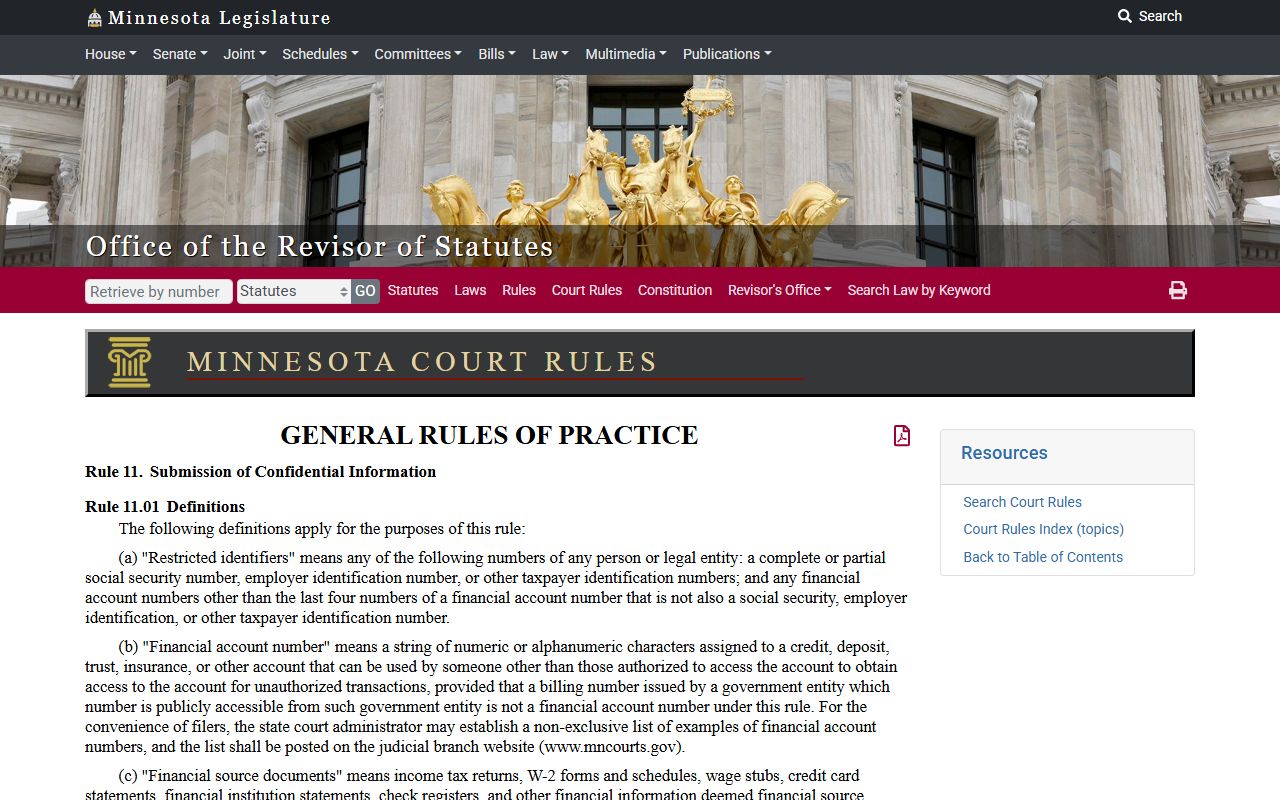
If you are filing documents in a probate case, reviewing Rule 11 before you submit anything helps you avoid privacy errors that could delay your case or result in court sanctions.
Note: Anyone may request copies of most probate court records in Minnesota without providing a reason, though in-person visits may require a valid ID for staff to pull the file.
E-Filing Probate Court Records in Minnesota
Minnesota requires electronic filing for certain probate participants. Under General Rule of Practice 14, all court-appointed guardians must use the MyMNGuardian online application to file annual personal well-being reports and affidavits of service. Conservators must use the MyMNConservator system to file annual accounts and inventories. Both requirements apply statewide. Self-represented parties can file on paper or choose to use the state's e-filing system. Documents filed electronically are treated as official court records. Certified copies may also be issued in electronic format. Most probate forms on mncourts.gov are compatible with the e-filing system so you can upload them directly after completing them.
Minnesota General Rule of Practice 14, posted at revisor.mn.gov, explains which users must e-file, how the MyMNGuardian and MyMNConservator systems work, and how electronic records are handled as official court documents.
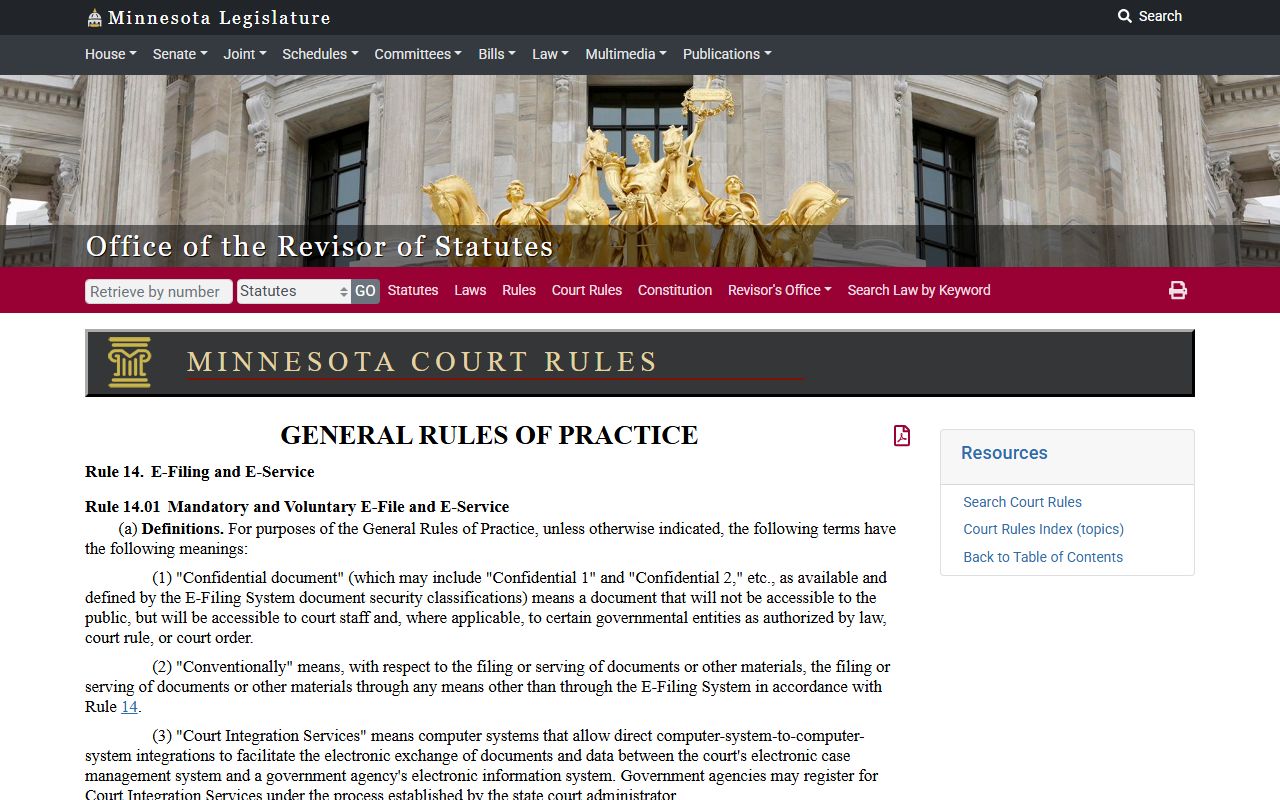
If you are a guardian or conservator appointed by any Minnesota court, these e-filing requirements apply to your annual reporting regardless of the county where the case is filed.
Legal Help With Probate in Minnesota
Several free and low-cost resources exist for people dealing with probate in Minnesota. The Minnesota State Law Library runs a Probate Brief Advice Clinic on the first Thursday of every month. Call (651) 297-7651 to ask about the schedule and how to join. The library is at Room G25, Minnesota Judicial Center, 25 Rev. Dr. Martin Luther King Jr. Blvd., St. Paul. Regular library hours are Monday through Friday, 8:00 AM to 4:30 PM. Staff can help with legal research during those hours even on non-clinic days. Visit mn.gov/law-library/ for more information on services and resources.
Legal aid organizations serve people who meet income guidelines. Mid-Minnesota Legal Aid covers the Twin Cities metro area and parts of central Minnesota. Reach them at (612) 334-5970. Southern Minnesota Regional Legal Services handles the southern counties at 1-877-696-6529. The statewide Self-Help Center at (651) 435-6535 can answer general procedural questions, Monday through Friday, 8:30 AM to 4:00 PM. Full text of the Minnesota Uniform Probate Code is available at revisor.mn.gov/statutes/cite/524/full. It covers intestate succession, will requirements, both types of probate, personal representative duties, creditor claims, and the closing of estates.
Minnesota Statutes Chapter 524, the Uniform Probate Code, is published in full at revisor.mn.gov with each article and subdivision linked for easy navigation across the full scope of Minnesota probate law.
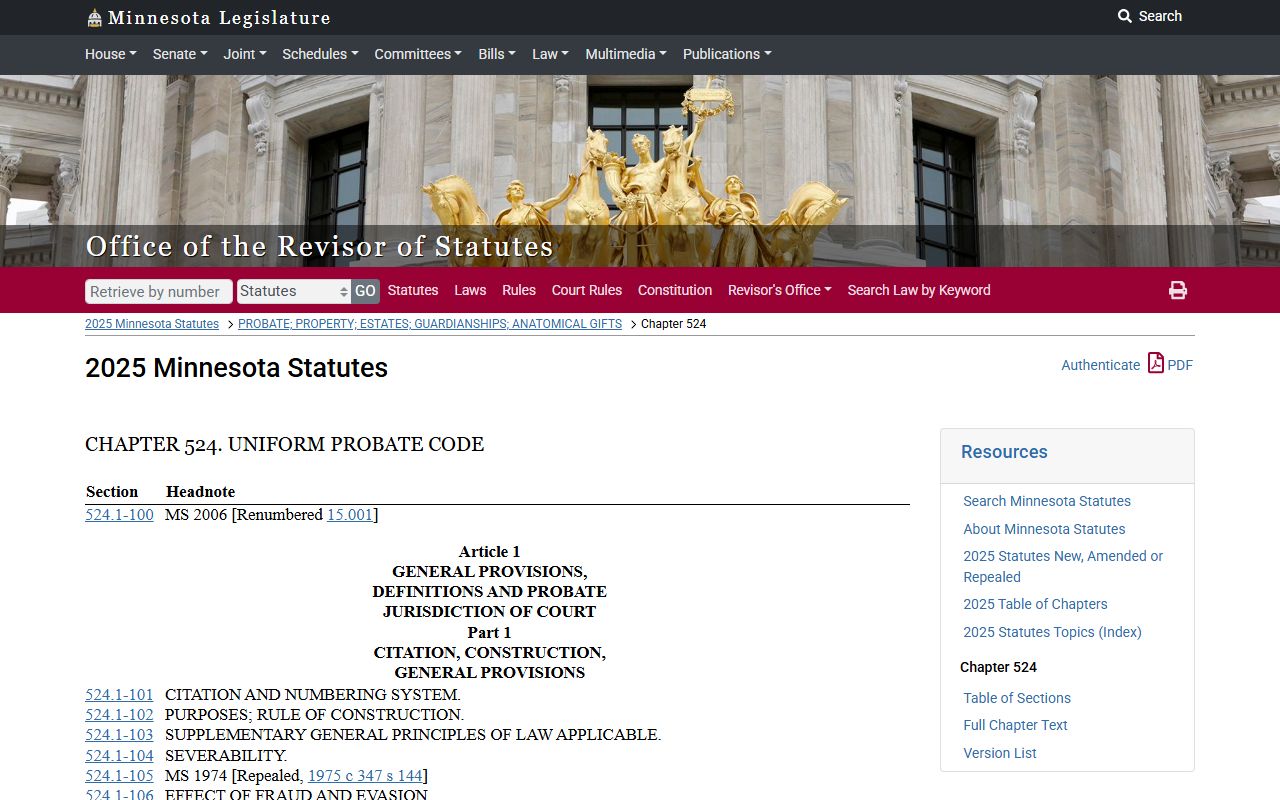
The chapter covers everything from who may inherit without a will to how a personal representative closes an estate and what happens when someone disputes the final distribution.
Browse Minnesota Probate Court Records by County
Each of Minnesota's 87 counties has its own District Court that handles probate filings. Pick a county below to find local contact information, courthouse address, fees, and resources for probate court records in that area.
View All 87 Minnesota Counties
Probate Court Records in Major Minnesota Cities
City residents file probate cases at the District Court in their county, not at a city office. Pick a city below to find courthouse contact information and access options for probate records in that area.