
Dakota County Probate Court Records
Dakota County probate court records are kept at the District Court in Hastings, Minnesota, one of the busiest court systems in the Twin Cities metro area. The First Judicial District handles all estate cases, wills, guardianships, and conservatorships filed in Dakota County. With three court locations serving this large suburban county, finding and accessing probate court records requires knowing which office to contact. This page explains how to search Dakota County probate records, where to get copies, and what laws apply.
Dakota County Overview
Dakota County District Court - Three Locations
Dakota County has three court locations serving different parts of this sprawling suburban county south of the Twin Cities. The main Judicial Center is at 1560 W. Highway 55, Hastings, MN 55033. The main probate phone number is (651) 377-7180. Court Administrator Maria King oversees operations at all three sites. All locations are open Monday through Friday, 8:00 a.m. to 4:30 p.m. Free parking is available on-site at each location.
The Western Service Center is at 14955 Galaxie Ave. West, Apple Valley, MN 55124, phone (952) 247-7099. The Northern Service Center is at 1 W. Mendota Road, Suite 140, West St. Paul, MN 55118, phone (651) 377-7190. Probate cases are filed through the main Judicial Center in Hastings, but you can get general information or direct certain inquiries to any of the three locations. You can also reach court administration at (651) 438-8100 or by email at courtadmin@courts.state.mn.us.
Dakota County is part of Minnesota's First Judicial District, which also includes Carver, Goodhue, Le Sueur, McLeod, Scott, and Sibley counties. The district court has original jurisdiction in all civil, family, probate, juvenile, criminal, and traffic cases filed in Dakota County.
What Dakota County Probate Records Cover
Dakota County probate court records document the legal process used to transfer a deceased person's assets to heirs and beneficiaries. Probate is required when someone dies with property in their name that cannot pass directly to a spouse or named beneficiary. The court appoints a personal representative, who collects estate assets, pays outstanding debts and taxes, and distributes what remains according to the will or, if no will exists, under Minnesota intestate succession law.
The records that build up in a Dakota County probate case file include the original will and any codicils, the petition to open the estate, the court's appointment order, an inventory of all estate property, creditor claims, accountings from the personal representative, and the final distribution order. Dakota County also handles guardianship and conservatorship matters within its probate division. These involve court oversight of arrangements made for adults who can no longer manage their own affairs due to disability, illness, or cognitive decline.
According to the Dakota County court, probate records include documents for wills, estates, guardianships, and conservatorships. Court records can be searched online through the Minnesota Court Records Online portal by case number, party name, or filing date. Certified copies cost $14 per document unless a judge waives the fee. Uncertified copies may be free or low-cost.
Note: Some probate documents are restricted from public access under Minnesota court rules. If you are a party to a Dakota County probate case, you can access the full file. Others may need to show a specific legal reason to see restricted records.
Searching Dakota County Probate Court Records Online
The Minnesota Court Records Online (MCRO) portal is the best starting point for any Dakota County probate case filed since 2015. It is free and searchable by party name, case number, or filing date. To filter for probate cases, use the advanced options and select "Probate or Mental Health" as the case type. MCRO shows case status, public documents, and basic filing details.
MCRO does not include all documents in a file, and older cases from before 2015 do not appear there. For those, contact the Hastings Judicial Center directly at (651) 377-7180 or (651) 438-8100. Staff can search older records and let you know what is available. Written requests by mail are also accepted at 1560 W. Highway 55, Hastings, MN 55033. Include the full name of the deceased, approximate date of death, and case number if available.
The Minnesota Historical Society probate research guide covers older Dakota County records held at the MNHS for genealogy research. The Minnesota State Law Library provides research support for legal questions related to Dakota County probate matters.
Dakota County Probate Court Records - Images
The Dakota County District Court page on the Minnesota Judicial Branch website lists all three court locations, hours, parking details, and current contact information for probate and other case types.
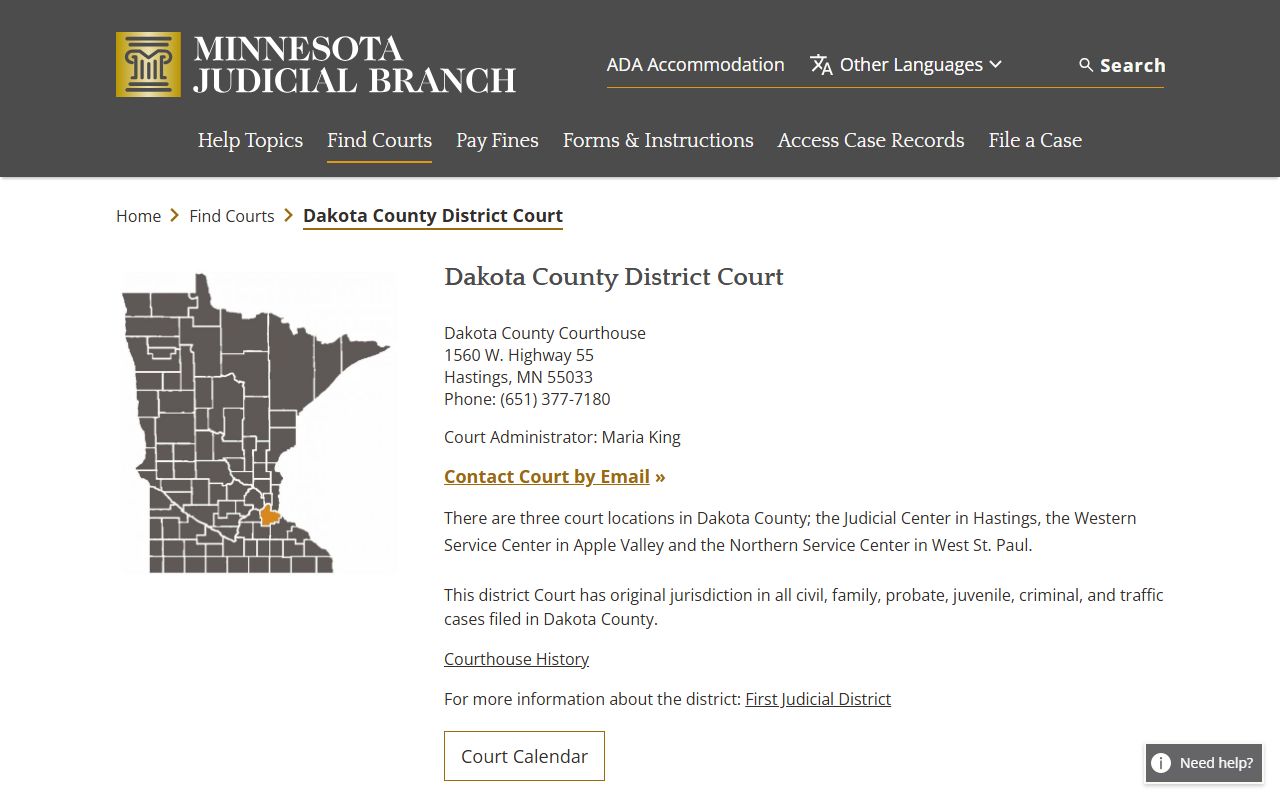
This page shows all three Dakota County court locations, including the Hastings Judicial Center where probate cases are filed, as well as the Apple Valley and West St. Paul service centers.
See the Dakota County court fee schedule for a full breakdown of probate filing costs, certified copy fees, and other charges that apply to estate cases in the First District Court.
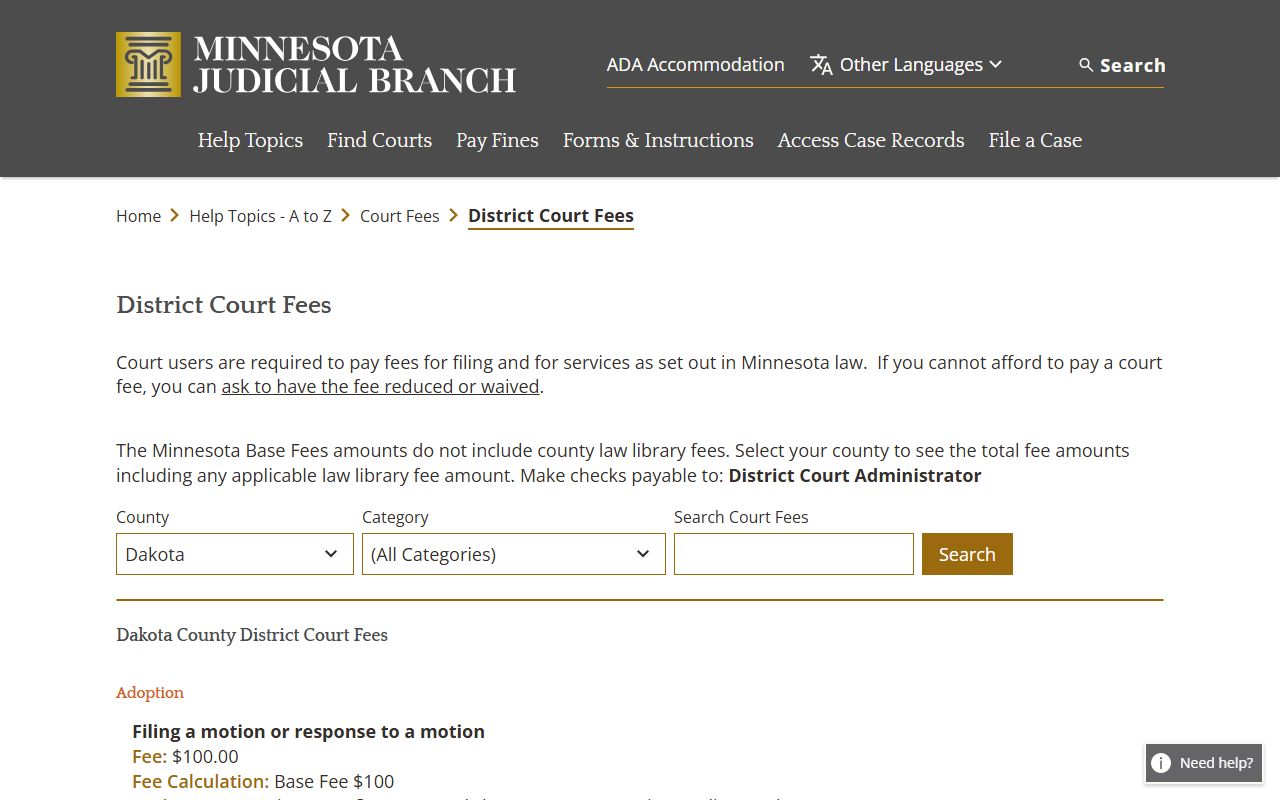
The fee schedule details first paper filing fees for estates, trusts, guardianships, and conservatorships in Dakota County, along with will deposit costs and motion filing charges.
Dakota County Probate Laws and Deadlines
All Dakota County probate matters are governed by the Minnesota Uniform Probate Code under Chapter 524. Minnesota gives personal representatives a choice between informal and formal probate. Informal probate skips the hearing and works for clear, uncontested estates with a valid will. Formal probate requires at least one court appearance and is used when there is a dispute, a complex estate, or questions about the will's validity.
Time limits apply in Dakota County just as in every other Minnesota county. Under Section 524.3-108, probate must be started within three years of the date of death. Missing this window generally means the estate cannot go through formal probate. For creditor claims, Section 524.3-803 requires claims to be filed within four months of the published notice to creditors or within one year of death, whichever comes first. Personal representatives should publish the required creditor notice promptly after appointment.
Small estates may skip probate entirely. Under Section 524.3-1201, if personal property totals less than $75,000 and there is no real estate, and at least 30 days have passed since death, heirs can use a small estate affidavit. The free affidavit form packet avoids the full probate filing fee entirely.
Dakota County Legal Aid and Self-Help Resources
Legal Assistance of Dakota County offers client intake at (952) 431-3200 for eligible residents who need help with probate and other civil legal matters. Southern Minnesota Regional Legal Services covers the area at 1-877-MY-MN-LAW (1-877-696-6529). The Dakota County Law Library is located at the Judicial Center in Hastings at 1560 Highway 55 and can be reached at (651) 438-8080. A second law library is at the Galaxie Library in Apple Valley at 14955 Galaxie Avenue.
All standard probate forms are free at the probate forms directory. The Minnesota probate help page explains each step of the process in plain language. If you are handling a Dakota County estate without an attorney, both of these resources are a good starting point. The First District self-help center can also answer procedural questions at (651) 435-6535 during regular business hours.
Cities in Dakota County
Dakota County is home to several large cities in the Twin Cities south metro, all of which file probate cases through the Hastings Judicial Center.
Other communities in Dakota County include Hastings, South St. Paul, West St. Paul, Farmington, Inver Grove Heights, Rosemount, and Mendota Heights. All probate filings for these areas go through the Dakota County District Court in Hastings.
Nearby Counties
Dakota County borders several counties in the Twin Cities metro and surrounding region, all part of the First Judicial District or neighboring districts.